 |
|
Contact Alex Chernov,
Certified Heater Mason
Member of MHA
WETT#8347
Tel. (519) 938-9166
Cell (416) 708-8139
alex.chernov@stovemaster.com
|
|
"Those, who in their new work follow laws of nature, cooperate with the Creator."
Antonio Gaudi
| Description | History
| Advantages |
Any masonry stove designer faces two main challenges:
- How to burn fuel the cleanest way?
- How to store more of the produced heat?
In most existing advanced stove design systems, the first goal is achieved by constructing fireboxes that create combustion environment as close to ideal as possible: high combustion temperatures, necessary amount of primary and secondary combustion air, turbulence in the gas flow as it leaves the firebox. Our system is not very different from others in its approach to this question. However, there is a significant difference in how we resolve the second challenge.
|
|
|
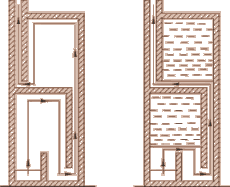
In most existing stove designs, gases from firebox are directed into a system of channels where they transfer their heat to surrounding masonry walls. Depending on the design, gases in such channels may go "up and down", and/or "side to side" before exiting into a chimney. Let's take a closer look at what is happening in such designs, especially at flow and behavior of the gases.
When the stove is fired, air flows into the firebox, and air's components participate in reaction of combustion. A mixture of various gases and small particles is produced as the result of the reaction. This mixture, called "gas flow" is moved inside the stove channels by chimney draft. In these designs, draft is the only force that makes the gases to move inside the stove. If there were no draft, there would be no movement at all.
It is well known that each change of direction in the gas flow creates resistance to the gas flow. The more "turns" ? more resistance is created to the gas flow and the weaker pulling force of the chimney draft becomes. Therefore, there is always a limit of how long the channels can be in these designs, and how much heat can be stored. Here, it is always a question of achieving the perfect balance: maximum length of channels without having the stove smoking and compromising the cleanness of burn. No wonder that such balance is difficult to achieve as many factors affect the gas flow. This is why, such systems are usually designed with "draft reserve" that means that "it is better to loose some heat than have the stove smoking". Obviously, this "reserve" lowers heat transfer efficiency of the stove.
As it has been said above, it is hard to achieve the perfect balance between the heat transfer efficiency and sufficient draft in these design systems. This is the reason why stoves, belonging to these systems, usually have standard proportions of the firebox and the channels that have been refined in numerous installations over the centuries. Finnish contraflow stoves, Swedish kakelugn, grundofens and kachelofens: they all belong to such systems. Wee call these "forced gas movement systems".
In contrast, solution in our System came from the question "what if we try not to force gases but rather cooperate with natural forces to facilitate movement in the stove?" It was found that force of gravity alone could do the job of moving the gases inside the stove?s heat exchanging portion if one just gives gases time and volume to move naturally. This principle led to creation of the entire System of stove design that was called "the System of Free Gas Movement". In stoves designed according to the System, movement of gases inside is natural, using gravity as the major moving force. Only the cooler portion of the gases is exhausted, leaving most heat inside. Another distinction of our stoves is that they often have chambers instead of channels. This is why these stoves are called "bell" or "chamber" stoves. Stoves built by this principle showed exceptional efficiency and revealed many advantages over forced movement systems.
|
 |
|
|
|